
Recalibrating Security-Community Relations: for the Prevention of Violent Extremism in Northern Kenya
Recalibrating Security-Community Relations: for the Prevention of Violent Extremism in Northern Kenya
Recalibrating Security-Community Relations for the Prevention of Violent Extremism in Northern Kenya
AUTHORS
Mohamedamin Issack, Samhita Ayaluri
In Northern Kenya’s counties of Garissa, Isiolo, and Mandera, the sight of a police Land Rover once meant trouble, prompting community members to withdraw rather than engage. Today, these same communities actively convene meetings with security actors, report suspicious activity through digital channels, and participate in joint security responses to threats. What changed?
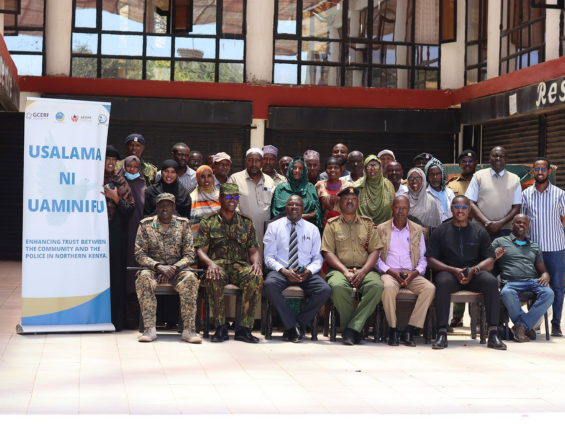
The ‘Usalama Ni Uaminifu’ (or Security is Trust) project, funded by the Global Community Engagement and Resilience Fund (GCERF) and led by the Regional Pastoralists Peace Link (RPPL) in a consortium with African Child Development Organization (ACDO) and Action for Sustainable Change (AFOSC), has been central to this change. The programme, that ran between January 2024 and December 2025, focussed on strengthening trust between communities and security actors as a strategy for preventing violent extremism. This distrust is one of the drivers of violent extremism in Kenya.
Garissa bordering Somalia, and Mandera bordering both Somalia and Ethiopia, face persistent cross-border security threats linked to Violent Extremist activities. Isiolo County occupies a strategic transit corridor connecting Northern and Central Kenya, and has experienced vulnerabilities linked to youth marginalisation, intercommunal tensions, and exposure to extremist influence networks. Across all three counties, strained pastoral livelihoods, unemployment, and weak trust between communities and security actors created conditions that heightened vulnerability to violent extremism. In such a context, the effectiveness of security interventions depends not only on state capacity but also on the quality of the relationship between communities and security actors. These relationships determine whether early warning signals are shared, whether communities feel safe reporting threats, and whether extremist narratives portraying the state as oppressive gain traction.
At the outset, baseline findings of the program revealed low levels of trust between community members and security actors. Only 15.1% of community members expressed strong confidence in community policing structures[1], and just 9.3% rated these structures as ‘very effective’ in preventing/countering terrorism. Historical grievances, including heavy-handed enforcement, perceived abuse of authority, and weak feedback mechanisms, had entrenched mistrust and discouraged cooperation.
Over a two-year period, RPPL and its consortium partners focused on rebuilding trust through structured dialogue, inclusive engagement, and mutual accountability. Rather than introducing entirely new systems, the project strengthened existing community-based mechanisms, particularly the Nyumba Kumi initiative.
Nyumba Kumi (or Ten Households) is a government-established community policing model in which clusters of ten neighbouring households share responsibility for local security. Each cluster is led by an elder or focal person who acts as the first point of contact for security concerns. Prior to the intervention, these structures were largely symbolic in the target counties. The elders described their roles as having “limited functional relevance,” with weak links to formal security actors and no clear reporting or feedback mechanisms.
The project addressed these gaps through targeted capacity strengthening. Across the three counties, 90 Nyumba Kumi Area Managers and Cluster Heads were trained in early warning identification, formal reporting procedures, conflict mediation, human rights processes, and coordination with Early Warning and Early Response (EWER) centres and police. Importantly, these community policing structures operate voluntarily, drawing motivation from community ownership and local legitimacy.
This was complemented by structural dialogue platforms, which brought together Nyumba Kumi Committees, community leaders, women, youth, and security actors to rebuild communication, clarify roles, and establish mutual accountability. These engagements extended into practical collaboration, including joint night patrols between Nyumba Kumi committees and security actors.
The project resulted in significant and measurable improvements in trust, engagement, and the effectiveness of community-security collaboration mechanisms. Confidence in community policing structures increased substantially, rising from 15.1% at baseline to 41.03% by the end of the intervention period. Similarly, perceptions of effectiveness improved, with the proportion of respondents rating these structures as ‘very effective’ in countering terrorism increasing from 9.3% to 30%. These shifts translated into behavioural change, with 65% of respondents reporting having shared a security concern with either the police or the EWER system within the past two years, and 66.2% of these reports were channelled through EWER centres. Awareness of these centres reached 83.4%, suggesting that the project not only strengthened trust but also enhanced knowledge and utilisation of formal reporting mechanisms.
Importantly, 82.25% of respondents stated that security conditions would deteriorate if community policing structures were removed, underscoring their perceived value and embeddedness within local security ecosystems. Within this framework, Nyumba Kumi elders emerged as a critical intermediary layer. By the end of the project, they were identified as the second most common first point of contact during security incidents (28.44%), surpassing direct engagement with police (16.41%) and second only to local Chiefs. Furthermore, 72% of these Nyumba Kumi Committees reported actively applying the skills acquired through the project to address real security or conflict-related issues, indicating a high level of practical knowledge transfer and sustained application. Collectively, these outcomes demonstrate that strengthening community-based structures can enhance both the reach and responsiveness of formal security systems, while simultaneously fostering trust and participation at the local level.
Security actors themselves recognised the effectiveness of this approach. As one police commander in Garissa noted:
Training the Nyumba Kumi system was a force multiplier. It extended our reach without requiring additional patrols or vehicles.”
— A Police Commander
Similarly, a police officer in Mandera East observed that greater trust in Nyumba Kumi elders led to more actionable intelligence.
From a community perspective, one elder in Isiolo captured this transformation succinctly:
We became the project’s eyes, ears, and mouth in the village. Training ten of us meant reaching a hundred households.”
— One Elder
This reflects Nyumba Kumi’s dual function as both an upward channel for information and a downward channel for trust, feedback, and accountability.
The project’s effectiveness was also rooted in its sensitivity to local cultural and religious contexts. In predominantly Muslim areas such as Garissa and Mandera, engagement with religious leaders was essential for legitimacy and acceptance. The project aligned its activities with community values and existing authority structures, ensuring that interventions were locally owned rather than externally imposed.
An Imam in Isiolo reflected on the shift in community-security relations through a powerful metaphor:
Security is like a body. The police are one limb, the elders are another, and the youth are yet another. If they do not work together, the body is weak and vulnerable to illness.”
— An Imam
The programme also addressed gender-specific security concerns. Institutional innovations, such as the Garissa Gender Desk, further strengthened inclusive engagement, particularly in addressing gender-specific security concerns. The sister-to-sister initiative between women community leaders and female security officers created a safe space to discuss sensitive issues affecting women and girls. The Gender Desk, previously underutilised, became more active and accessible as women and girls gained confidence to report cases.
One of the women from the community members described stepping into support for a vulnerable young person struggling with drug use and isolation, noting that:
I was driven by the courage I gained through the sister-to-sister Sessions. I decided to take on the role of a mother, even though I’m not related to him. I knew this was the role of a woman in peace building to protect and save our youth.”
— A Woman, Community Member
Despite significant progress, trust remains uneven across locations. In some areas, gains have plateaued or declined due to unresolved incidents of alleged police misconduct. Security actors also acknowledge persistent gaps in providing feedback to communities after reports are made. Nonetheless, the project has established a strong foundation for sustained collaboration. Seven Memoranda of Understanding and community-security resolutions have been developed, formalising mechanisms for continued engagement and sustainability.
The transformation in Garissa, Isiolo, and Mandera demonstrates that sustainable security and the prevention of violent extremism do not emerge from strict enforcement of security measures alone, but from relationships built on trust, accountability, and shared responsibility. What has taken shape is not simply a more effective security system, but a different understanding of security itself – one that is rooted in community ownership and sustained by those who live with its consequences every day. This is reflected in the project’s sustainability findings: a majority of community members report confidence in their own capacity to maintain these gains, while locally embedded structures such as Nyumba Kumi and councils of elders continue to function as trusted and indispensable stabilisers.
[1] Community policing denotes an approach to policing based on voluntary cooperation between police and the local community. Its central feature is joint identification of problems and joint problem-solving, with the police remaining responsive to community needs. Police and public retain distinct responsibilities for crime prevention and the maintenance of order. As part of this programme, several community policing structures were engaged. Community actors included Nyumba Kumi elders and focal persons (the household-level structure that, per the National Police Service Community Policing Framework, anchors community policing and strengthens collaboration between citizens and formal security institutions), chiefs and assistant chiefs, community elders, religious leaders (imams, pastors, madrasa leaders), youth representatives, women representatives, civil society organizations (CSOs), and peace committees. Security actors were engaged through the County Security Intelligence Committees (CSIC), comprising National Police Service officers, Administration Police, the Directorate of Criminal Investigations, National Government Administration Officers (NGAO), the Kenya Wildlife Service (KWS), the Kenya Forest Service (KFS), and the Kenya Defence Forces (KDF), where all its members have been trained on community policing and the Prevention of Violent Extremism (P/CVE), and use this training to develop County Action Plans (CAPs).
Note: The endline assessment drew on responses from 524 participants surveyed across the three program counties including community members, youth, women, religious leaders, elders, civil society actors, and security personnel. The structured survey was complemented by focus group discussions and key informant interviews.
This article is written by Mohamedamin Issack, Monitoring and Evaluation Learning Manager at Regional Pastoralist Peace Link (RPPL) and Samhita Ayaluri, Monitoring, Evaluation and Reporting Officer at GCERF.