
Supporting school reintegration In Issyk-Kul
Supporting school reintegration In Issyk-Kul
Supporting school reintegration
In Issyk-Kul
Location
Issyk-Kul, Kyrgyzstan
Focus
Reintegration
IMplemented by
SOS Children’s Villages
Targeted educational, language, and psychosocial assistance has enabled three returned children in the Issyk‑Kul region to enter school, overcome language barriers, and integrate into their local community.
When Zhanat returned from Syria to her home village of Don-Talaa in Issyk-Kul region, her family situation remained complex. She came back in 2024 with her six-year-old son, Ismail, while her two older daughters, Fatima and Zukhra, aged 10 and 11, stayed behind in Türkiye, in a children’s home receiving treatment.
The girls were finally reunited with their family in the Kyrgyz Republic in January 2025. But soon after, their mother left for Bishkek in search of work, leaving the children in the care of their elderly grandparents.
A needs assessment by SOS Children’s Villages revealed just how difficult reintegration would be. The children spoke only Arabic. Without gestures, they could barely communicate with peers, teachers, or even their own grandparents.
They had little prior schooling. Their household ran on basic living conditions and the grandfather’s irregular income, with no resources to spare for clothing, school materials, or tutoring. Early signs of learning and behavioural difficulties were already beginning to show.
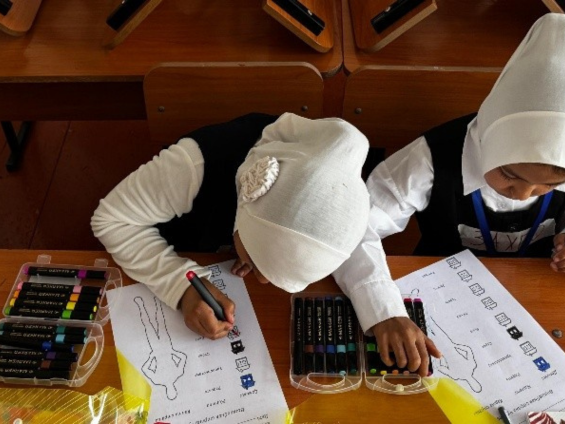
In response, the programme stepped in with practical, wide-ranging support centred on education and social adaptation. The children were enrolled in age-appropriate school grades and given regular tutoring in Kyrgyz language and mathematics. Essential school supplies and clothing followed, alongside psychosocial and group activities designed to build their confidence, communication, and connection with peers.
Within a relatively short period, marked improvements were observed.
The children picked up basic to functional Kyrgyz, enough to take part in class and in everyday conversation. Their academic performance stabilised as tutors closed the learning gaps, while psychosocial activities helped support positive behaviour and classroom engagement.
Teachers noticed it too: better attendance, more confidence, greater participation in group activities. Today, the children attend school regularly and interact actively with their classmates. They take part in lessons and school life without the language and social barriers that once held them back.
This experience shows why combining language learning, tutoring, and psychosocial support matters so much for reintegrating children. By addressing practical needs alongside emotional and educational ones, the programme allowed for a smoother transition into school and community life, laying the foundation for lasting stability.