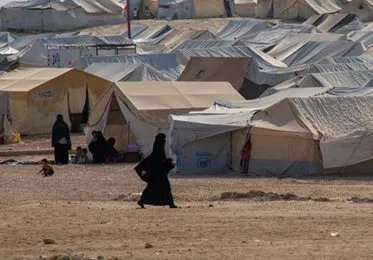
The article presents an overview of the situation in the camps, drawing on GCERF's work and experience.
Observatory on Radicalization and Counterterrorism in Europe (ReaCT)
Article
The article presents an overview of the situation in the camps, drawing on GCERF's work and experience.
The article presents an overview of the situation in the camps, drawing on GCERF's work and experience.
Observatory on Radicalization and Counterterrorism in Europe (ReaCT)
Podcast
In this episode of Turning Points, host Basile Ema Ebede, GCERF’s Regional Manager for South-East Asia, is joined by Aisah Ponce Macabuat, Project Manager at ECOWEB Philippines, to explore how education, vocational training and livelihood development can support rehabilitation and reintegration.
Listen to episode →Report
Recommendations on integrating MHPSS into R&R programmes, drawing on country-level experiences and practical lessons.
Read report →Podcast
Faith leaders can be among the most trusted people in a community. But what happens when that trust is brought into the work of rehabilitation and reintegration? In this episode of Turning Points, host Samhita Ayaluri explores how faith leaders and youth actors can contribute to preventing violent extremism, and building stronger, more resilient communities.
Listen to episode →Podcast
Before rehabilitation and reintegration can begin, there is a fundamental question: who has the right to return? In this episode of Turning Points, host Basile Ema Ebede, GCERF’s Regional Manager, is joined by Aoife Devlin, a law and politics graduate from University College Dublin. Together they examine the legal challenges surrounding the repatriation of ‘foreign terrorist fighters’ and their families from Northeast Syria — exploring the role of international law, citizenship, and state responsibility.
Listen to episode →Report
Explores international and domestic legal approaches to the repatriation of FTFs from camps in Syria.
Read report →Podcast
Mental health and psychosocial support is one of the most important aspects of rehabilitation and reintegration. In this episode of Turning Points, host Isabela Ottoni is joined by three guests who bring very different perspectives. Together they explore why trust is the foundation of everything and why some of the most important mental health work is done not by psychologists alone but also by teachers, faith leaders, and neighbours.
Listen to episode →Podcast
In this episode, GCERF's Mona El-Wali is joined by Kim Saado, GCERF's National Advisor for Syria, and Jeyana Ahmad, Programme Manager at Salam for Hope Foundation, GCERF's implementing civil society partner in Syria, to explore a critical and often unseen moment in the rehabilitation and reintegration process: the time before a family leaves a camp in northeast Syria. They discuss what pre-departure preparation really means in practice, and the psychological, legal, and practical steps that must happen before return.
Listen to episode →Report
Recommendations on how Communications can help build trust and transparency in R&R.
Read report →Podcast
In the first episode of Turning Points, GCERF's Lilla Schumicky-Logan, Deputy Executive Director, sits down with Hatem Shatnawi, Regional Manager for Iraq, Syria and Yemen, and Tariq Hasan, National Advisor for Iraq, to discuss what rehabilitation and reintegration really looks like on the ground, the challenges of working in conflict-affected settings, and why community-led approaches are essential.
Listen to episode →